Dihexa/
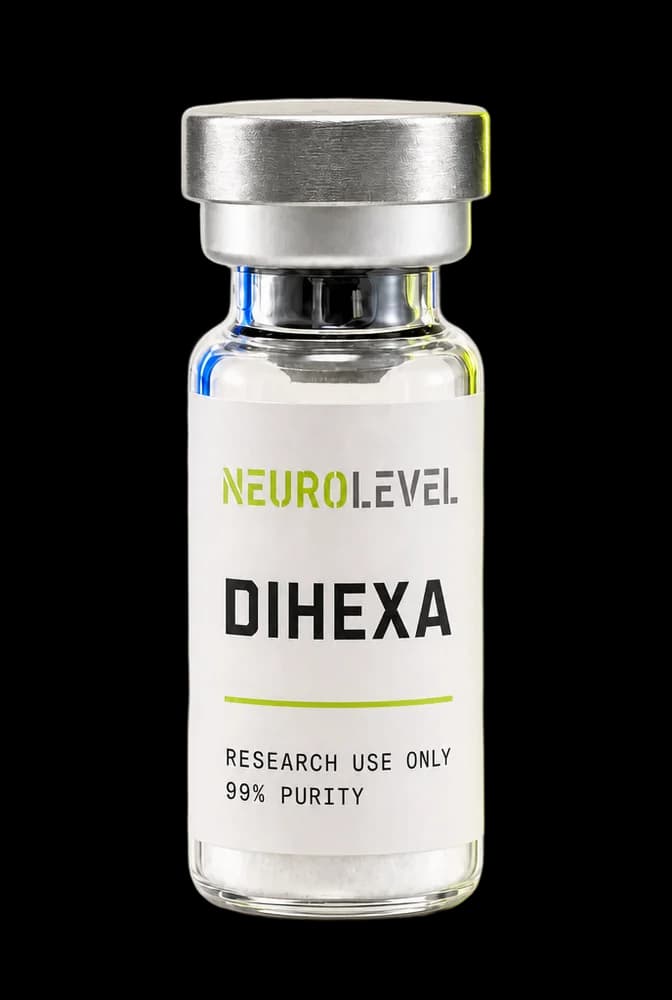
Sheet
- Molecular Weight
- 504.67 g/mol
- Molecular Formula
- C₂₇H₄₄N₄O₅
- CAS
- 1401708-83-5
- Assayed Purity
- ≥ 98.0% (release spec)
- Source
- Domestic · 3rd-party verified
- Storage
- -20°C lyophilized
Mechanism
HGF/c-Met Pathway
Synaptogenic Activity
Angiotensin IV Analog
Dihexa (N-hexanoic-Tyr-Ile-(6)-aminohexanoic amide) is a synthetic angiotensin IV-derived peptidomimetic. In published research, the procognitive and synaptogenic effects of angiotensin IV-derived peptides including Dihexa were reported to be dependent on activation of the hepatocyte growth factor (HGF) / c-Met receptor system in rodent models (McCoy et al, 2014, PMID 25187433).
In a transgenic mouse model of Alzheimer-type pathology (APP/PS1), the angiotensin IV analog Dihexa was reported to improve cognition- and memory-related endpoints, with the authors implicating PI3K/AKT signaling (Sun et al, 2021, PMID 34827486). The compound is structurally characterized as a small peptidomimetic targeting the HGF/c-Met axis. For research purposes only.
Citations
- [01]The procognitive and synaptogenic effects of angiotensin IV-derived peptides are dependent on activation of the hepatocyte growth factor/c-met system.↗
- [02]AngIV-Analog Dihexa Rescues Cognitive Impairment and Recovers Memory in the APP/PS1 Mouse via the PI3K/AKT Signaling Pathway.↗
Literature citations verified against PubMed: 2026-07-11.
Questions
Dihexa (N-hexanoic-Tyr-Ile-(6)-aminohexanoic amide) is a synthetic angiotensin IV-derived peptidomimetic. In published research, the procognitive and synaptogenic effects of angiotensin IV-derived peptides including Dihexa were reported to be dependent on activation of the hepatocyte growth factor (HGF) / c-Met receptor system in rodent models (McCoy et al, 2014, PMID 25187433). Referenced for mechanism only; for research purposes only.