Semax/
Met-Glu-His-Phe-Pro-Gly-Pro · MEHFPGP
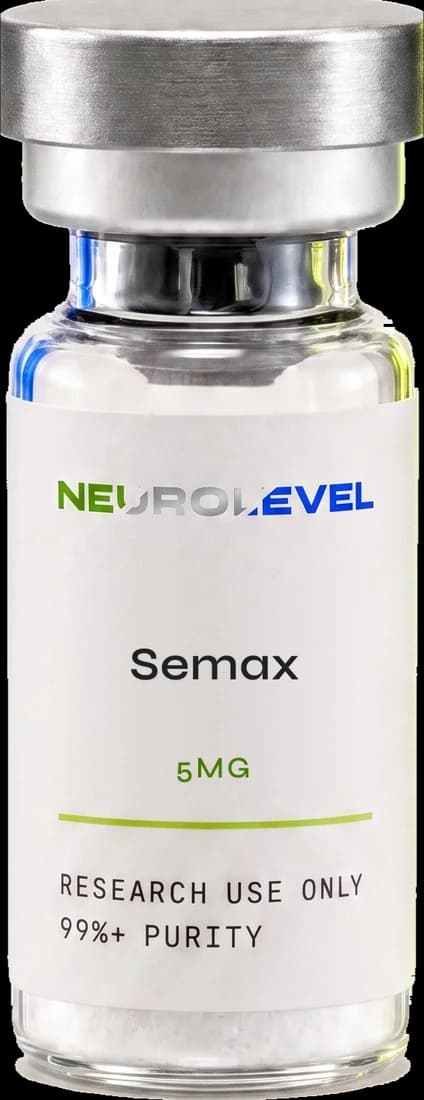
Sheet
- Molecular Weight
- 813.93 g/mol
- Molecular Formula
- C₃₇H₅₁N₉O₁₀S
- Assayed Purity
- 99%+
- Standard Vial
- 5-11mg lyophilized
- Source
- Domestic · 3rd-party verified
- Storage
- -20°C lyophilized
Certificate of Analysis
Sample certificate of analysis from an independent third-party accredited lab. Identity by LC-MS, purity by RP-HPLC. The fields below are the sample certificate format for the referenced batch.
Mechanism
BDNF Upregulation
Neurotrophic Signaling
Redox & Stress Modulation
In published research, Semax (an analogue of adrenocorticotropin fragment 4-10) was shown to bind specifically and increase brain-derived neurotrophic factor (BDNF) protein levels in the rat basal forebrain (Dolotov et al, 2006, PMID 16635254).
In a rat model of chronic unpredictable stress, the ACTH(4-10) synthetic analog Semax was evaluated for behavioral and stress-response endpoints (Inozemtseva et al, 2024); a separate study examined Semax and a derivative in an animal model of Alzheimer-type pathology (Radchenko et al, 2025).
In vitro, Semax has been characterized as a copper-chelating peptide that decreases Cu(II)-catalyzed reactive oxygen species production and amyloid-β cytotoxicity (Tomasello et al, 2025). The compound is a synthetic heptapeptide analog of ACTH fragment 4-10.
Citations
- [01]Semax, an analogue of adrenocorticotropin (4-10), binds specifically and increases levels of brain-derived neurotrophic factor protein in rat basal forebrain.↗
- [02]Antidepressant-like and antistress effects of the ACTH(4-10) synthetic analogs Semax and Melanotan II on male rats in a model of chronic unpredictable stress.↗
- [03]The Potential of the Peptide Drug Semax and Its Derivative for Correcting Pathological Impairments in the Animal Model of Alzheimer's Disease.↗
- [04]Semax, a Copper Chelator Peptide, Decreases the Cu(II)-Catalyzed ROS Production and Cytotoxicity of Aβ by Metal Ion Stripping and Redox Silencing.↗
- [05]Semax peptide targets the μ opioid receptor gene Oprm1 to promote deubiquitination and functional recovery after spinal cord injury in female mice.↗
Literature citations verified against PubMed: 2026-07-11.
Questions
In published research, Semax (an analogue of adrenocorticotropin fragment 4-10) was shown to bind specifically and increase brain-derived neurotrophic factor (BDNF) protein levels in the rat basal forebrain (Dolotov et al, 2006, PMID 16635254). Referenced for mechanism only; for research purposes only.