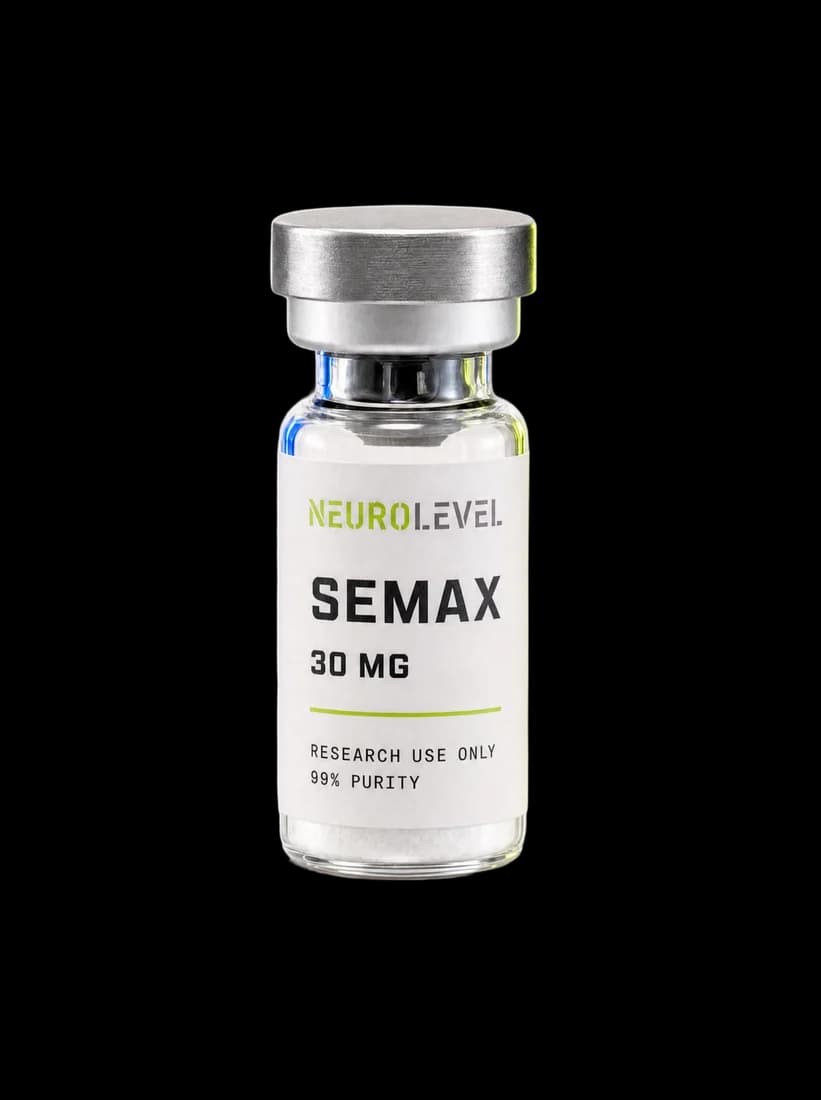
Semax is a synthetic peptide studied in research for its effects on neurotrophic signaling pathways. It is structurally derived from a fragment of adrenocorticotropic hormone (ACTH), specifically the ACTH(4-7) region, with an added Pro-Gly-Pro sequence at the C-terminus. It is catalogued under CAS number 80714-61-0 with a molecular formula of C₃₇H₅₁N₉O₁₀S and a molecular weight of 813.93 g/mol. The compound is supplied as a lyophilized powder intended solely for research purposes, not for human use.
Within peptide research, Semax is grouped with the melanocortin-related compounds because of its ACTH-fragment origin. What distinguishes it as a research compound is that the fragment retains activity associated with neurotrophic signaling while lacking the hormonal corticotropic activity of the full ACTH molecule.
What is the molecular structure of Semax?
Semax is a heptapeptide with the sequence Met-Glu-His-Phe-Pro-Gly-Pro and a molecular weight of 813.93 g/mol. The first four residues (Met-Glu-His-Phe) correspond to the ACTH(4-7) fragment, while the terminal Pro-Gly-Pro is a synthetic addition. This C-terminal tripeptide is the structural feature most associated with the compound's metabolic stability in published research, because the proline residues slow enzymatic degradation that would otherwise rapidly clear short peptide fragments.
The peptide is produced through solid-phase peptide synthesis followed by purification, and the research-grade material is supplied at a stated purity of 99%+ by HPLC. The lyophilized form is a white to off-white powder. As with all short peptides, its structural integrity is sensitive to temperature, oxidation, and moisture, which is why cold storage is standard for research handling.
How does the Pro-Gly-Pro sequence affect Semax?
Published research associates the C-terminal Pro-Gly-Pro sequence with extended stability relative to the unmodified ACTH(4-7) fragment. Unmodified short peptide fragments are rapidly degraded by peptidases, which limits their usefulness in research models. The proline-containing terminal sequence introduces structural constraints that slow this degradation, lengthening the window over which the compound remains intact in model systems.
This stabilization strategy, attaching a proline-rich terminal sequence to a bioactive fragment, appears across several research peptides. In Semax, it is the defining modification that separates the research compound from the parent ACTH fragment. Research interest centers on how this modification preserves the neurotrophic-associated activity of the fragment while removing the rapid-clearance limitation.
What does research describe about Semax and neurotrophic signaling?
Published research describes Semax in the context of neurotrophic signaling, particularly its associations with brain-derived neurotrophic factor (BDNF) and nerve growth factor (NGF). Studies in cell-culture and preclinical models examine how the compound influences the expression of these neurotrophic factors and their downstream signaling. BDNF and NGF are central to research on neuronal growth, differentiation, and synaptic processes.
The compound is also studied for effects on the signaling cascades downstream of neurotrophic factor receptors, including pathways involved in cellular stress responses. Neurolevel makes no therapeutic or cognitive-outcome claims regarding Semax; it is studied solely for its effects on these neurotrophic signaling mechanisms in research settings. Published mechanistic work frames these effects at the level of gene expression and receptor signaling in model systems rather than behavioral or clinical outcomes.
What is known about Semax and the melanocortin system?
Because Semax derives from an ACTH fragment, published research examines its relationship to the melanocortin system. ACTH is a melanocortin peptide, and fragments of it retain structural features relevant to melanocortin receptor research. Studies investigate how Semax interacts with components of this system in model contexts, separate from the corticotropic (cortisol-stimulating) activity of full-length ACTH.
This separation is a key research point: the ACTH(4-7) fragment used in Semax does not carry the hormonal activity that would stimulate the adrenal axis, which is why the compound is studied for neurotrophic-associated mechanisms rather than as a corticotropic agent. Research characterizes this distinction at the level of which structural regions of ACTH drive which activities.
How should Semax be handled and stored for research?
Semax is supplied as a lyophilized powder and is stored at −20°C to preserve structural integrity. As a short peptide, it is sensitive to repeated freeze-thaw cycles, oxidation, and humidity. Research handling practices that support reproducibility include maintaining cold storage, limiting freeze-thaw exposure, and protecting the lyophilized material from moisture.
The compound is shipped as a lyophilized powder, the form in which it is most stable, so the researcher's storage conditions after receipt are the main variable affecting integrity over time. This article does not provide reconstitution or preparation instructions; handling protocols are determined by the researcher according to experimental requirements and applicable regulations.
How does Neurolevel source Semax?
Neurolevel supplies Semax as a research-grade compound at a stated purity of 99%+ by HPLC, with mass spectrometry identity confirmation. Batch test data is published on the product page, and the certificate of analysis for a specific batch is available on request.
Researchers can review specifications, available sizes, and related cognitive research compounds by browsing the Semax product page or the full compound catalog. All material is intended for laboratory research use only.
This compound is a research chemical intended for laboratory and scientific research purposes only. It is not a drug, supplement, or food, and is not intended to diagnose, treat, cure, or prevent any disease. Neurolevel does not sell products intended for human use. Researchers are responsible for compliance with all applicable local, state, and federal regulations.